
News
Public blame coalition and Trump for price rises
20 Aug 26
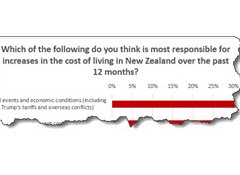
A majority of New Zealanders say increases in the cost of living over the past 12 months are due to international events or the coalition Government’s handling of the economy, rather than the previous Labour government, Newsroom reports.
Newsroom says: "The findings of the Horizon Research poll of 1028 adults, which ran from August 5 to 11, 2026, undercut the National Party’s argument that Labour is to blame for persistent inflation."
When asked which factor was most responsible for inflation over the past year, 31 percent of respondents selected “International events and economic conditions (including Donald Trump’s tariffs and overseas conflicts)” and 29 percent selected the current coalition Government. Seventeen percent blamed the previous Labour government.

Putting “International events and economic conditions” aside, responsibility allocated to the current coalition Government and to the previous Labour Government largely follows party vote lines; i.e. those who voted for the National Party or ACT placed significantly less responsibility on the current coalition Government and significantly more responsibility on the previous Labour Government. New Zealand First voters also follow this trend but the differences are not statistically significant.
Those who voted for one of the current opposition parties in parliament placed significantly more responsibility on the current coalition Government and significantly less responsibility on the previous Labour Government.
Top priorities to reduce cost of living
Large numbers want the Government to prioritise cutting electricity and gas bills (72%) and grocery prices (70%).

Respondents believe the top 3 priorities for the Government are:
- Electricity and gas bills: 72%. There were no significant differences across household income and personal income groups. This peaked at 80% for those aged 55 plus, primarily among those aged 65-74 years. “Electricity and gas bills” was more important than average for respondents who were Retired/Superannuitants or Unemployed/Beneficiaries, one parent families with one or two children at home, people living in extended family situations, Māori and 2023 Labour Party voters. It was less important than average for under 35s, Aucklanders, students, Pasifika respondents and 2023 ACT voters.
- Grocery prices: 70%. There were no significant differences across the regions or household and personal income groups. “Grocery prices” was more important than average for those aged 35-44 years, females, Labourer/ Agricultural / Domestic Workers, Home-makers, Unemployed/ Beneficiaries, one-parent families with children at home, Māori and 2023 Labour Party voters. It was less important than average for respondents aged 75 years or more, males and 2023 ACT and National Party voters.
- Fuel prices (petrol and diesel): 61%. This was more important than average for those aged 65-74 years, females, Unemployed/ Beneficiaries and Northlanders. It was less important than average for under 35s, males, Professional /Senior Government Officials, Business Manager/Executives, Pasifika respondents, those with household income or personal income of more than $200,000 per year, and 2023 ACT and Green Party voters.
Full Horizon Research survey report
The full survey report is here. It also provides results on how much influence the public think each of the three parties in the coalition government have, and how accountable each is for the coalition's decisions.
The survey was commissioned by Horizon as part of our public interest research programme.
The complete Newsroom report on this survey also provides comment from the coalition parties.
HorizonPoll Online Survey system
and website developed by BEWEB
Copyright © 2010. HorizonPoll incorporating ShapeNZ - Listening to New Zealand

